
How the Federal Government Can Attract Employees

by Chelsea Jarosh, Industry Analyst
Nearly half of the federal workforce will be eligible to retire within the next five years (45%). Retirements can vary depending on a variety of factors, including economic conditions, workforce demographics, and individual retirement decisions.
Alas, I am unable to predict future events. Therefore, I am unable to provide an accurate percentage of the federal workforce that will absolutely retire in five years. However, it is worth noting that the federal government, like many other organizations, is facing potential workforce challenges due to the aging of its workforce. Many federal employees are part of the baby boomer generation, which is reaching retirement age. The silver tsunami is expected to result in a significant number of retirements in the coming years. The federal government has been actively working to address succession planning and knowledge transfer to ensure a smooth transition as employees retire and new employees are hired.
Attracting early-career talent to the federal workforce
Because the federal workforce is aging, there has been a huge emphasis around hiring early-career talent. In July 2023, the Biden administration announced its plans to create more opportunities for young people in the federal government. Their goal is to strengthen and empower the federal workforce by hiring 35,000 early-career talent and interns through the federal internship program in fiscal 2023. The overall purpose of hiring early-career talent would be to offset the impacts of the tenured experts retiring within the next five years.
The federal government has historically struggled to promote and leverage internship and partnership programs to attract early-career talent. Introduced on December 1, 2021, the Building the Next Generation of Federal Employees Act was implemented to expand access to federal internships, provide an internship preference, and allow federal agencies to reimburse student interns for their expenses. The purpose of the bill is to provide a pathway for interns that have successfully completed their internship to gain an advantage in the federal hiring process.

10 ways the government can attract employees
The federal government can take several steps to bolster the federal workforce, including:
- Competitive Salaries. Offering competitive salaries on par with or exceeding the private sector can be a key factor in attracting top talent. The federal government should conduct regular market research to ensure that their salary scales are competitive and adjust them accordingly.
- Robust Benefits Packages. Providing comprehensive benefits packages, including health insurance, retirement plans, and paid time off, can be appealing to potential employees. The federal government should ensure that its benefits packages are attractive and competitive to attract and retain highly qualified candidates.
- Professional Development Opportunities. Offering opportunities for professional growth and development can be a significant incentive for potential employees. Providing training programs, mentoring, and other forms of career development is important.
- Flexibility in Work Arrangements. Flexible work arrangements — telecommuting, flexible hours, and remote work options — can be attractive to employees seeking work-life balance. The federal government should consider implementing flexible work policies to accommodate the needs of its workforce.
- Clear Career Paths. Establishing clear career paths and advancement opportunities can encourage employees to join and stay with the federal government. Providing career progression plans, performance evaluations, and opportunities for promotion can motivate employees to excel in their roles.
- Workplace Culture. Creating a positive workplace culture that values diversity, equity, and inclusion can be a significant factor in attracting employees. The federal government should promote a supportive and inclusive work environment where employees feel valued, respected, and empowered.
- Recruitment Marketing. Recruitment marketing strategies, such as targeted advertising, social media outreach, and branding, can help the federal government attract top talent. Highlighting the benefits and opportunities of working for the federal government can make it more appealing to potential employees.
- Streamlined Hiring Process. Lengthy and complex application procedures can be a deterrant to young talent. Simplifying and expediting the federal government’s hiring process can help. A streamlined and efficient hiring process can demonstrate the federal government’s commitment to attracting and retaining top talent.
- Mission and Purpose. Highlighting the impact employees can make through their work in the federal government can be a compelling motivator for candidates. Emphasizing the mission and purpose of the agency, and how it aligns with an individual’s values, can attract passionate employees.
- Work-Life Balance. Emphasizing work-life balance and promoting policies that support employees, such as flexible work hours, telecommuting options, and family-friendly policies, can be attractive to potential employees.
By implementing these strategies, the federal government can attract and retain top talent. This will ensure a capable and motivated federal workforce to serve the needs of the nation.
Final Thoughts
The government and citizens suffer when the best and brightest talent choose to work for the private sector versus government. Not only is the lack of top talent an issue, but so is attracting early career-talent. Over the past few years, the federal government has seen a shift in an increasing age gap within the workforce. Civil service experts predict a catastrophic federal retirement surge. Yet, they do not have replacements lined up to fill the positions of experienced retirees. One potential answer is to implement the outlined strategies and streamline recruiting and hiring process. This will get us all to the next generation of federal employees poised for success.
Questions? Please reach out to Chelsea on LinkedIn, or e-mail at cjarosh@govexec.com
Sources:
https://news.clearancejobs.com/2020/08/31/5-reasons-the-federal-government-struggles-to-attract-top-talent/ https://www.whitehouse.gov/wp-content/uploads/2022/03/ap_7_strengthening_fy2023.pdf
Related Posts

Defense AI News Roundup (August 2026)
The Pentagon and NSA are expanding their access to commercial AI models for defense and intelligence operations, while emerging research highlights the new cyber threats posed by autonomous AI agents.
State and Local AI News Roundup (August 2026)
State and local governments are increasingly implementing data center moratoriums while adopting targeted AI solutions, such as Prince William County’s data-protection platform and a $100 million OpenAI Foundation initiative for public-health research.
Federal AI News Roundup (August 2026)
The Labor Department is considering using AI to triage a backlog of reasonable-accommodation requests from federal employees with disabilities, raising important governance questions about balancing administrative efficiency with privacy, fairness, and human oversight.

AI in June (2026)
Explore key AI policy and technology developments from June 2026, including the Trump administration’s national security memorandum, OpenAI’s integration into Pentagon platforms, and new legislative proposals for military AI oversight.

AI in May (2026)
May 2026 marked a pivotal shift toward enterprise-scale government AI adoption with developments that underscore the transition from government experimentation to operational maturity.

Inside the Federal Buyer’s Mindset: What Changed in 2025 and What It Means for Contractors in 2026
The federal contracting marketplace underwent an unprecedented “recalibration” in 2025, learn more about what’s changed and what it means for contractors in 2026.

8 AI Trends to Watch in 2026
2026 is the year AI goes from bet to baseline in federal government. Explore 8 key AI trends, from institutionalization and operational reality to cybersecurity risks and DoD’s focus on reliable defense applications.

AI in December (2025)
A look at December’s top AI news in government: The House Task Force report, DHS’s DHSChat launch, and the White House’s 1,700+ federal AI use case inventory.

7 Ways BD & Sales Teams Can Use Federal Personas for Competitive Advantage
Explore 7 strategies for BD and sales teams to use research-based federal personas to sharpen pursuit strategy, tailor messaging, boost credibility, and gain a competitive edge in government contracting.

AI in August (2025)
Key AI news from August 2025: GSA launched USAi.Gov for federal AI adoption, the Pentagon’s Advana platform faced cuts and setbacks, and the Army tested smart glasses for vehicle maintenance. Also, the Department of Labor unveiled a national AI workforce strategy, and Colorado lawmakers began revising the state’s pioneering AI Act.

Deep Dive: Department of Treasury
A look inside Treasury’s 2026-era tech strategy: AI isn’t a standalone budget line — but ~$48.8 M funding for a centralized fraud-detection platform points to growing use of chatbots, generative AI pilots, taxpayer services, fraud monitoring, and data-driven automation under its IT-modernization efforts.

Decoding OMB Memorandums M-25-21 and M-25-22
Explains Office of Management and Budget (OMB) M‑25‑21 and M‑25‑22 — new federal‑AI directives that replace prior guidance, empower agencies to adopt AI faster, and streamline procurement, while aiming to balance innovation, governance and public trust.

News Bite: AI Slop, Jon Oliver, and (Literally) Fake News
Examines the rise of ‘AI slop’ — cheap, AI-generated content masquerading as real media — and how it’s fueling viral fake news, degrading digital discourse, and undermining trust online.

Deep Dive: Department of Defense
Overview of the Department of Defense’s FY 2026 budget: $961.6 billion total, with heavy investment in AI, unmanned aerial, ground, maritime, and undersea systems — spotlighting a modernization push across all domains.

AI in July (2025)
Federal AI Policy Heats Up in July: The Trump administration unveiled its “America’s AI Action Plan,” prompting a lawsuit over deregulation and a battle with states. Also featuring: a new defense bill with AI provisions and GSA’s $1 ChatGPT deal for federal agencies.

AI in Government: A Question of Trust
Explores how the use of AI by government agencies raises fundamental questions of trust — weighing the benefits of efficiency, fraud detection and streamlined services against serious risks around bias, transparency, accountability, and public confidence.

Insights at a Glance: May 2025
A data driven rundown of the latest federal AI, policy and government‑tech developments from May 2025.
AI in April (2025)
April’s AI news: New White House policies, controversial federal agency automation, military digital overhaul, the TAKE IT DOWN Act, and plans to integrate AI in K-12 education.

Insights at a Glance: March 2025
A data driven rundown of the latest federal AI, policy and government‑tech developments from March 2025.
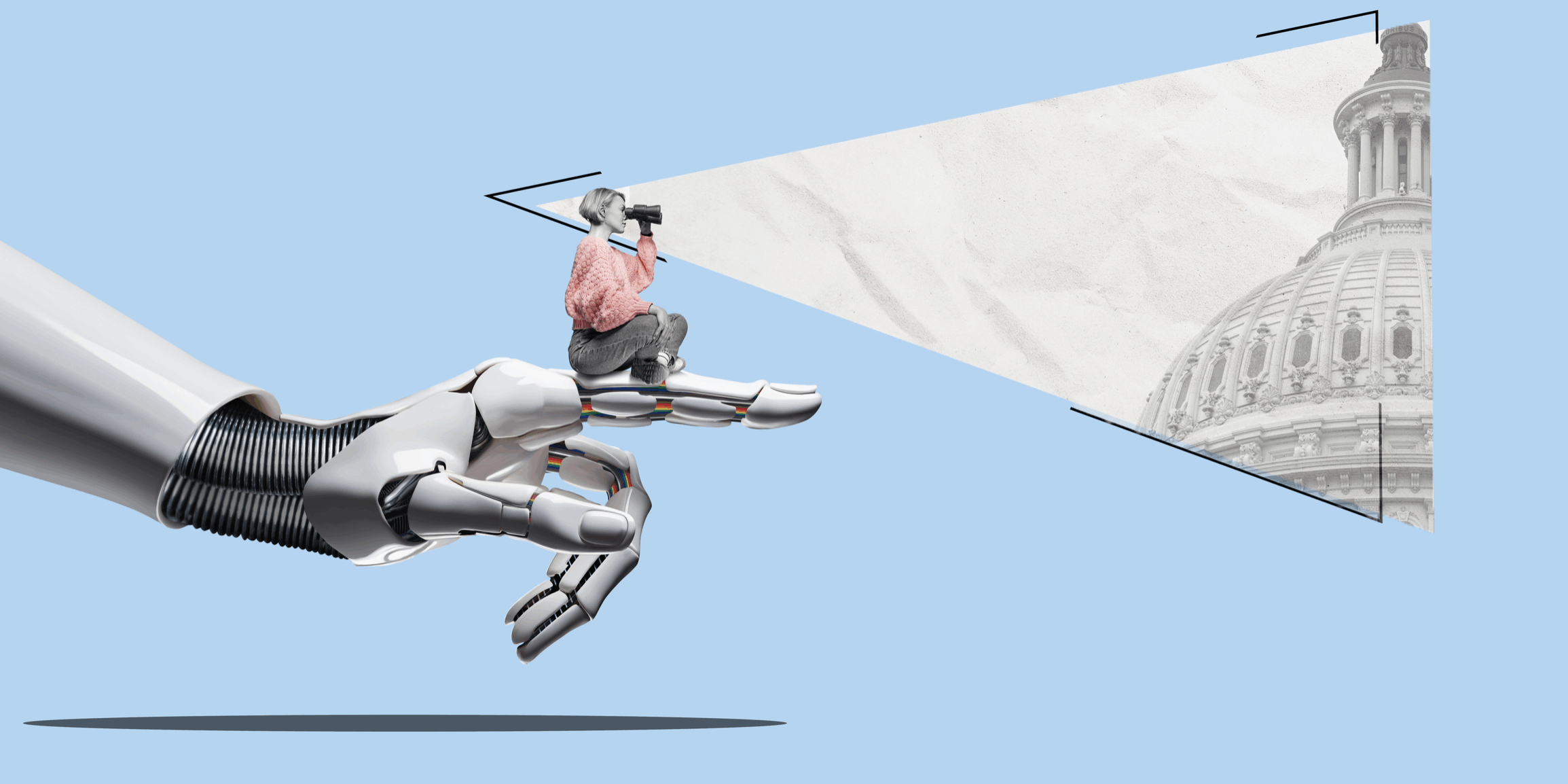
Policy Dive: AI in the First Week of Trump
Covers the first‑week AI moves by the new administration — from revoking prior federal AI safeguards to launching a sweeping AI‑domination agenda that prioritizes innovation and global competitiveness over prior guardrails.