
AI in December (2025)

Written by Emily Wolfteich
Senior Industry Analyst
The House AI Task Force released its first bipartisan report.
The report’s key recommendations focus on seven specific areas:
- Identifying AI issue novelty
- Promoting AI innovation
- Protecting against AI risks and harms
- Empowering government with AI
- Affirming the use of a sector-specific regulatory structure
- Taking an incremental approach
- Keeping humans at the center of AI policy discussions.
DHS launched an internal chatbot to support its workforce.
The AI-powered tool, known as DHSChat, was internally developed using underlying software similar to commercially available tools like ChatGPT, and operates in a closed environment to leverage non-public data. Director of DHS AI Corps wrote in a blog post that DHSChat will help its 19,000 employees in “summarizing complex documents and reports, generating computer code, and streamlining repetitive tasks like data entry.”
The White House released its annual inventory of over 1,700 AI use cases in the federal government.
The list, which is mandated by a 2020 Trump-era executive order, consolidates individual agency AI use cases, and has more than doubled from the 710 reported last year. The repositories include current use cases as well as those that are both upcoming and retired. This is also the first year that OMB has released the inventory on the code repository GitHub, allowing for improved cross-collaboration.
To read additional thought leadership from Emily, connect with her on LinkedIn.
Related Posts
Defense AI News Roundup (August 2026)
The Pentagon and NSA are expanding their access to commercial AI models for defense and intelligence operations, while emerging research highlights the new cyber threats posed by autonomous AI agents.
State and Local AI News Roundup (August 2026)
State and local governments are increasingly implementing data center moratoriums while adopting targeted AI solutions, such as Prince William County’s data-protection platform and a $100 million OpenAI Foundation initiative for public-health research.
Federal AI News Roundup (August 2026)
The Labor Department is considering using AI to triage a backlog of reasonable-accommodation requests from federal employees with disabilities, raising important governance questions about balancing administrative efficiency with privacy, fairness, and human oversight.
AI in June (2026)
Explore key AI policy and technology developments from June 2026, including the Trump administration’s national security memorandum, OpenAI’s integration into Pentagon platforms, and new legislative proposals for military AI oversight.
AI in May (2026)
May 2026 marked a pivotal shift toward enterprise-scale government AI adoption with developments that underscore the transition from government experimentation to operational maturity.

Inside the Federal Buyer’s Mindset: What Changed in 2025 and What It Means for Contractors in 2026
The federal contracting marketplace underwent an unprecedented “recalibration” in 2025, learn more about what’s changed and what it means for contractors in 2026.

8 AI Trends to Watch in 2026
2026 is the year AI goes from bet to baseline in federal government. Explore 8 key AI trends, from institutionalization and operational reality to cybersecurity risks and DoD’s focus on reliable defense applications.

7 Ways BD & Sales Teams Can Use Federal Personas for Competitive Advantage
Explore 7 strategies for BD and sales teams to use research-based federal personas to sharpen pursuit strategy, tailor messaging, boost credibility, and gain a competitive edge in government contracting.
AI in August (2025)
Key AI news from August 2025: GSA launched USAi.Gov for federal AI adoption, the Pentagon’s Advana platform faced cuts and setbacks, and the Army tested smart glasses for vehicle maintenance. Also, the Department of Labor unveiled a national AI workforce strategy, and Colorado lawmakers began revising the state’s pioneering AI Act.
Deep Dive: Department of Treasury
A look inside Treasury’s 2026-era tech strategy: AI isn’t a standalone budget line — but ~$48.8 M funding for a centralized fraud-detection platform points to growing use of chatbots, generative AI pilots, taxpayer services, fraud monitoring, and data-driven automation under its IT-modernization efforts.

Decoding OMB Memorandums M-25-21 and M-25-22
Explains Office of Management and Budget (OMB) M‑25‑21 and M‑25‑22 — new federal‑AI directives that replace prior guidance, empower agencies to adopt AI faster, and streamline procurement, while aiming to balance innovation, governance and public trust.

News Bite: AI Slop, Jon Oliver, and (Literally) Fake News
Examines the rise of ‘AI slop’ — cheap, AI-generated content masquerading as real media — and how it’s fueling viral fake news, degrading digital discourse, and undermining trust online.

Deep Dive: Department of Defense
Overview of the Department of Defense’s FY 2026 budget: $961.6 billion total, with heavy investment in AI, unmanned aerial, ground, maritime, and undersea systems — spotlighting a modernization push across all domains.

AI in July (2025)
Federal AI Policy Heats Up in July: The Trump administration unveiled its “America’s AI Action Plan,” prompting a lawsuit over deregulation and a battle with states. Also featuring: a new defense bill with AI provisions and GSA’s $1 ChatGPT deal for federal agencies.

AI in Government: A Question of Trust
Explores how the use of AI by government agencies raises fundamental questions of trust — weighing the benefits of efficiency, fraud detection and streamlined services against serious risks around bias, transparency, accountability, and public confidence.

Insights at a Glance: May 2025
A data driven rundown of the latest federal AI, policy and government‑tech developments from May 2025.
AI in April (2025)
April’s AI news: New White House policies, controversial federal agency automation, military digital overhaul, the TAKE IT DOWN Act, and plans to integrate AI in K-12 education.

Insights at a Glance: March 2025
A data driven rundown of the latest federal AI, policy and government‑tech developments from March 2025.
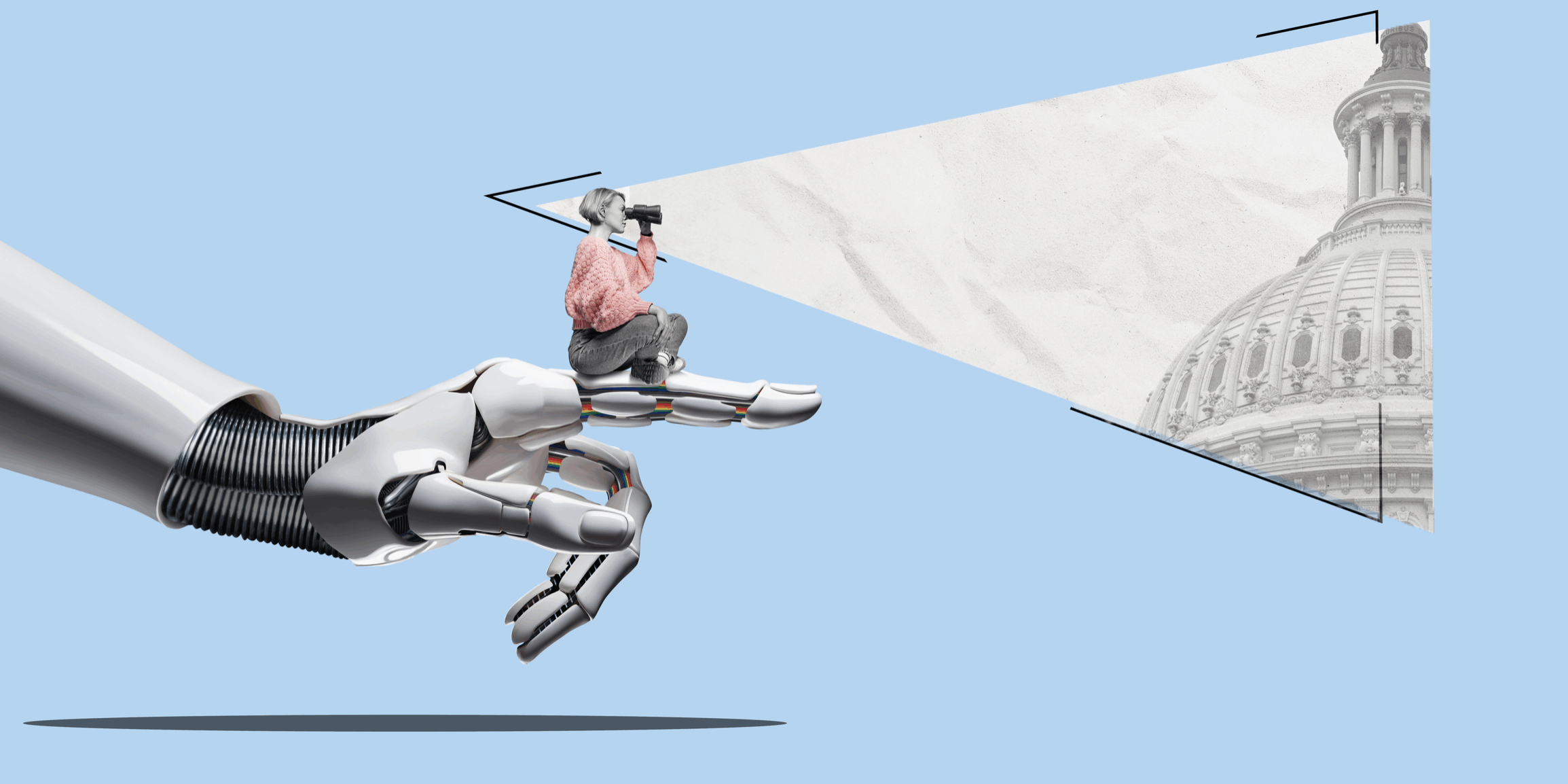
Policy Dive: AI in the First Week of Trump
Covers the first‑week AI moves by the new administration — from revoking prior federal AI safeguards to launching a sweeping AI‑domination agenda that prioritizes innovation and global competitiveness over prior guardrails.
AI in January (2025)
Explore the new Trump administration’s deregulatory shift, the massive “Stargate Project” with tech giants, the emergence of a high-performing, cost-effective Chinese AI model (DeepSeek), the launch of OpenAI’s ChatGPT Gov, and key ethical priorities set by the NAIAC.