
AI in July (2025)

Written by Emily Wolfteich
Senior Industry Analyst
The Trump administration released a comprehensive policy roadmap, "America's AI Action Plan," along with three new executive orders. The plan aims to secure U.S. leadership in AI by promoting deregulation, fostering innovation, and investing in infrastructure and workforce development. It also explicitly targets what the administration calls "woke AI" by directing federal agencies to only procure AI tools that are "ideologically neutral" and by recommending the National Institute of Standards and Technology remove diversity, equity, and inclusion references from its AI Risk Management Framework. The policy also encourages states to abandon their own AI regulations by making federal funding contingent on deregulation.
2. The House passes defense bill with AI-related provisions.
The House version of the National Defense Authorization Act (NDAA) for fiscal year 2026 included significant provisions related to AI and defense. The bill mandates a study on how to use AI for military targeting to improve accuracy and minimize civilian casualties. It also gives a boost to AI, satellite, and other technology programs to help the U.S. maintain a technological edge over adversaries. The bill aims to streamline the process for the Department of Defense to acquire technology from non-traditional defense contractors.
3. OpenAI offers $1 ChatGPT access to the General Services Administration (GSA).
The GSA signed a partnership agreement with OpenAI, a move intended to support the Trump administration's AI Action Plan and help federal agencies adopt advanced AI tools. Through this pact, the GSA will offer OpenAI's ChatGPT Enterprise to agencies at a steep discount of $1 per agency for the next year. This initiative is part of a broader government-wide effort to accelerate the adoption and use of AI technology within the federal workforce.
4. Lawsuit challenges the administration's use of AI in deregulation.
A public policy nonprofit, Democracy Forward, filed a lawsuit to obtain records related to the Trump administration's use of AI in governmental decision-making. The lawsuit specifically seeks to uncover whether the administration is using AI to rewrite or repeal regulations. This legal challenge highlights growing concerns among watchdog groups about a lack of transparency and potential pitfalls, such as a reliance on flawed AI systems, in the government's use of the technology for regulatory purposes.
5. Controversy over AI Action Plan's stance on state regulations.
The AI Action Plan has drawn criticism for its stance on state and local AI regulations thanks to its plan to tie a state's eligibility for federal grants to the hospitality of its legal climate toward private-sector AI companies, effectively pressuring states to drop their own regulations. Critics, including more than 40 state attorneys general and 17 Republican governors, voiced concern that this move is an overreach of federal power that could undermine states' ability to create their own civil liberties protections. The provision is seen by some as a workaround for a controversial moratorium on state AI laws that failed in Congress.
To read additional thought leadership from Emily, connect with her on LinkedIn.
Related Posts
AI in June (2026)
Explore key AI policy and technology developments from June 2026, including the Trump administration’s national security memorandum, OpenAI’s integration into Pentagon platforms, and new legislative proposals for military AI oversight.
AI in May (2026)
May 2026 marked a pivotal shift toward enterprise-scale government AI adoption with developments that underscore the transition from government experimentation to operational maturity.

Inside the Federal Buyer’s Mindset: What Changed in 2025 and What It Means for Contractors in 2026
The federal contracting marketplace underwent an unprecedented “recalibration” in 2025, learn more about what’s changed and what it means for contractors in 2026.

8 AI Trends to Watch in 2026
2026 is the year AI goes from bet to baseline in federal government. Explore 8 key AI trends, from institutionalization and operational reality to cybersecurity risks and DoD’s focus on reliable defense applications.
AI in December (2025)
A look at December’s top AI news in government: The House Task Force report, DHS’s DHSChat launch, and the White House’s 1,700+ federal AI use case inventory.

7 Ways BD & Sales Teams Can Use Federal Personas for Competitive Advantage
Explore 7 strategies for BD and sales teams to use research-based federal personas to sharpen pursuit strategy, tailor messaging, boost credibility, and gain a competitive edge in government contracting.
AI in August (2025)
Key AI news from August 2025: GSA launched USAi.Gov for federal AI adoption, the Pentagon’s Advana platform faced cuts and setbacks, and the Army tested smart glasses for vehicle maintenance. Also, the Department of Labor unveiled a national AI workforce strategy, and Colorado lawmakers began revising the state’s pioneering AI Act.
Deep Dive: Department of Treasury
A look inside Treasury’s 2026-era tech strategy: AI isn’t a standalone budget line — but ~$48.8 M funding for a centralized fraud-detection platform points to growing use of chatbots, generative AI pilots, taxpayer services, fraud monitoring, and data-driven automation under its IT-modernization efforts.

Decoding OMB Memorandums M-25-21 and M-25-22
Explains Office of Management and Budget (OMB) M‑25‑21 and M‑25‑22 — new federal‑AI directives that replace prior guidance, empower agencies to adopt AI faster, and streamline procurement, while aiming to balance innovation, governance and public trust.

News Bite: AI Slop, Jon Oliver, and (Literally) Fake News
Examines the rise of ‘AI slop’ — cheap, AI-generated content masquerading as real media — and how it’s fueling viral fake news, degrading digital discourse, and undermining trust online.

Deep Dive: Department of Defense
Overview of the Department of Defense’s FY 2026 budget: $961.6 billion total, with heavy investment in AI, unmanned aerial, ground, maritime, and undersea systems — spotlighting a modernization push across all domains.

AI in Government: A Question of Trust
Explores how the use of AI by government agencies raises fundamental questions of trust — weighing the benefits of efficiency, fraud detection and streamlined services against serious risks around bias, transparency, accountability, and public confidence.

Insights at a Glance: May 2025
A data driven rundown of the latest federal AI, policy and government‑tech developments from May 2025.
AI in April (2025)
April’s AI news: New White House policies, controversial federal agency automation, military digital overhaul, the TAKE IT DOWN Act, and plans to integrate AI in K-12 education.

Insights at a Glance: March 2025
A data driven rundown of the latest federal AI, policy and government‑tech developments from March 2025.
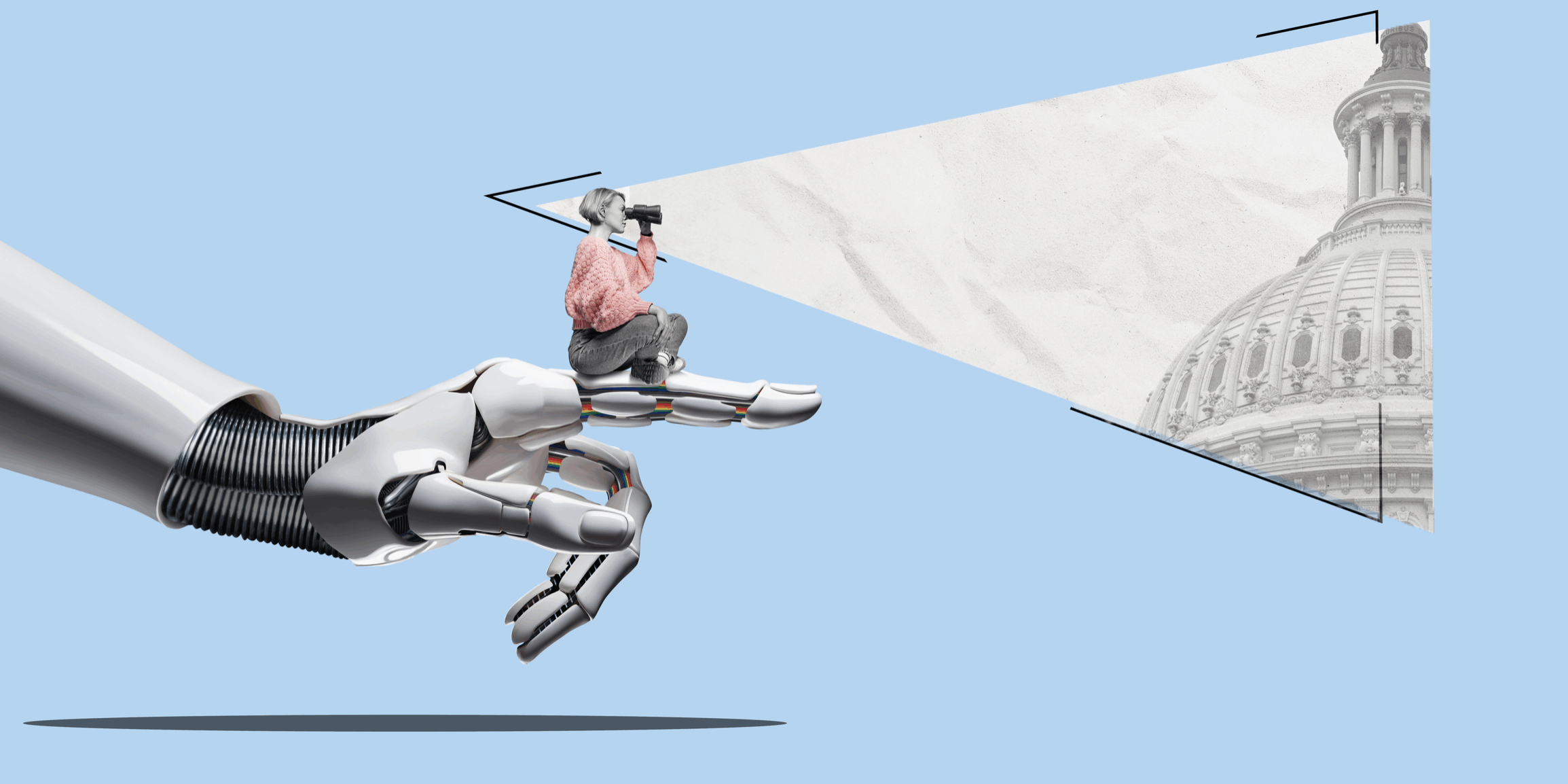
Policy Dive: AI in the First Week of Trump
Covers the first‑week AI moves by the new administration — from revoking prior federal AI safeguards to launching a sweeping AI‑domination agenda that prioritizes innovation and global competitiveness over prior guardrails.
AI in January (2025)
Explore the new Trump administration’s deregulatory shift, the massive “Stargate Project” with tech giants, the emergence of a high-performing, cost-effective Chinese AI model (DeepSeek), the launch of OpenAI’s ChatGPT Gov, and key ethical priorities set by the NAIAC.

Artificial Intelligence & the Government: Who’s Driving the Car?
The GAO’s report on the federal government’s adoption of AI is as comprehensive as it can be – but do we like what we see?

How government can experience the Great Stay
As the labor market begins to stabilize, experts predict FY 2024 to be the year of “The Great Stay” among the federal workforce.
AI & the Pentagon: Cautiously Curious
As AI hype increases across the public and private sectors, organizations are weighing the possibilities (and risks) the tech creates.