
AI & the Pentagon: Cautiously Curious
By David Hutchins and Emily Wolfteich, Senior Industry Analysts at Government Business Council
AI is an increasingly hot topic across both the public and private sectors as organizations weigh the world of possibilities that this tech can create – and the associated risks. Within the military, this technological potential means an edge on the battlefield, better and faster intel analysis and decision support for leaders, and improved training and strategic planning operations. However, it can also introduce vulnerabilities that can impact national security, warfighting capabilities, and soldier safety. As the Pentagon begins to explore how it can leverage artificial intelligence, we take a quick look at the difference between traditional and generative AI and what this might mean for the future of the military.
What is Generative AI?
Generative AI is different from “traditional” AI in a few key ways. “Traditional” AI, things we think of as useful for automation or data analytics, is limited by rules and patterns that tell it what to do. Generative AI, on the other hand, learns from enormous reserves of data and algorithms to create new content that resembles something a human would write or create – think ChatGPT or AI-generated art. It does this by using neural networks similar to those the human brain uses to build its own patterns of thinking and understanding relationships, This allows the program to learn and train relatively unsupervised through the model’s unlabeled data pool. Generative AI can trawl through terabytes of data quickly and provide summaries and some analysis; it can respond to questions or provide suggestions based on what it’s learned; and it can theoretically quickly respond to cybersecurity threats or anomalies from surveillance equipment. For the military, where rapid analysis can make crucial differences, this “brain” that never gets tired could be a powerful tool.
What are the risks/challenges?

Though both traditional AI and generative AI offer exciting opportunities to use and understand data in revolutionary ways, there are significant risks associated with both. Traditional and generative AI both work with and learn from enormous datasets. However, if the integrity of that data is compromised (is it accurate, complete, and consistent?), the chances that errors or omissions will be replicated and reified is extremely problematic. Generative AI, for example, can produce synthetic data based on past learnings to augment or replace real data. This synthetic data is, in turn, used to train AI models. If the synthetic data is based on inaccurate, biased, or unreliable real data, those flaws will be replicated. Generative AI can also “hallucinate,” or produce incorrect responses that still sound credible. Relying too much on this tool without appropriate and safe oversight from humans poses real national security risks – as does the possibility that adversaries will use the same tools against American interests.
What is Task Force Lima?
Announced by the Department of Defense (DOD) on August 10th, 2023, Task Force Lima is a Generative AI and large language model (LLM) task force operated through the Chief Digital and Artificial Intelligence Office’s (CDAO) Algorithmic Warfare Directorate. Task Force Lima was created to focus the Department’s exploration and responsible fielding of generative AI capabilities and explore how adversaries might use generative AI to harm the United States.
Under the direction of DoD CDO Craig Martell, Task Force Lima will assess, synchronize, and employ generative AI capabilities across the DoD. At the same time, Task Force Lima must ensure the Department is able to design, deploy, and use generative AI technologies responsibly and securely. Task Force Lima will also be responsible for providing guidance and recommendations to policy-making bodies related to generative AI.
How will the DOD use Task Force Lima?
Because of the relatively nascent stage of generative AI, there are still many questions around how this technology should be used, especially when considering military applications. A key objective of Task Force Lima is to find a set of use cases where generative AI can aid the DoD in its functions. The Department is already looking to leverage generative AI to enhance its capabilities in areas such as administrative operations, strategic decision-making, and warfighting.

Administrative Operations
Generative AI could prove especially useful in the category of administrative operations. Effectively processing the enormous amount of data held by the DoD can be extremely time-consuming and has been an operational challenge for the department. A well-trained generative AI could be used to rapidly locate files and data, filter and select the most valuable information, respond to questions, and provide text summaries of lengthy documents.

Strategic Decision-making
Generative AI can also group information from various datasets and quickly identify patterns. This allows military personnel to draw more accurate conclusions and create response plans based on a more complete picture of a situation. Generative AI can also provide military personnel with a more detailed understanding of an area of operation by collecting and analyzing reports, documents, news, and other information sources. Ultimately, the DoD hopes to use the rapid analytical abilities of generative AI to augment decision-makers, especially in high-stress situations where quick response times are essential.

Warfighting
While the risks are currently still too high for AI to direct any kinetic warfare (i.e. autonomous firepower), this could very well be the DoD’s goal on the horizon. As autonomous and semi-autonomous systems become increasingly present in the U.S. military, generative AI may one day be used to inform the decision of these systems.
Closing thoughts
Generative AI, although still relatively new in its development, could one day benefit nearly every aspect of military operations. From logistics to medical care, from training personnel to guiding autonomous systems, AI will be integral to the future of military operations, logistics, and decision-making. Task Force Lima’s cautious but curious approach is an important step in the U.S. military’s utilization of AI and a critical effort in keeping pace with potential adversaries. Despite its challenges, the DOD must keep pace with developments in AI, or risk losing its technological edge.
“As we navigate the transformative power of generative AI, our focus remains steadfast on ensuring national security, minimizing risks, and responsibly integrating these technologies. The future of defense is not just about adopting cutting-edge technologies but doing so with foresight, responsibility, and a deep understanding of the broader implications for our nation.”
— Deputy Secretary of Defense Dr. Kathleen Hicks (Source: DOD Announces Establishment of Generative AI Task Force)
To read additional thought leadership from Emily and David, connect with them on LinkedIn.
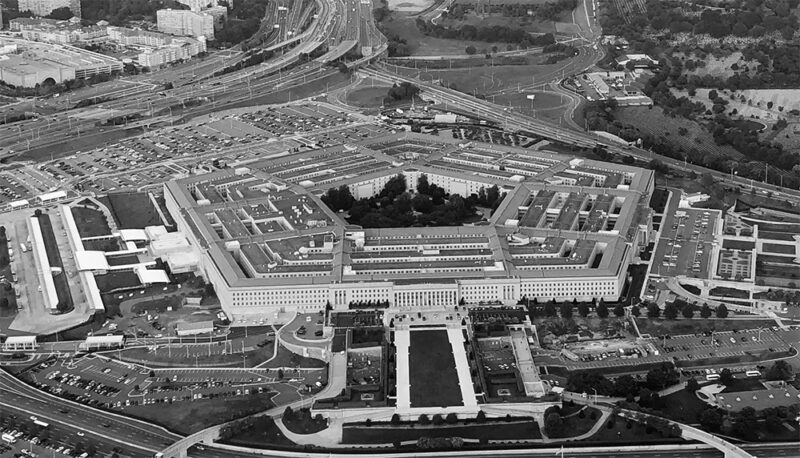
Photo 1 – by Wiyre Media on Flickr
Photo 2 – by Stockasso Media on Envato Elements
Related Posts
Defense AI News Roundup (August 2026)
The Pentagon and NSA are expanding their access to commercial AI models for defense and intelligence operations, while emerging research highlights the new cyber threats posed by autonomous AI agents.
State and Local AI News Roundup (August 2026)
State and local governments are increasingly implementing data center moratoriums while adopting targeted AI solutions, such as Prince William County’s data-protection platform and a $100 million OpenAI Foundation initiative for public-health research.
Federal AI News Roundup (August 2026)
The Labor Department is considering using AI to triage a backlog of reasonable-accommodation requests from federal employees with disabilities, raising important governance questions about balancing administrative efficiency with privacy, fairness, and human oversight.

AI in June (2026)
Explore key AI policy and technology developments from June 2026, including the Trump administration’s national security memorandum, OpenAI’s integration into Pentagon platforms, and new legislative proposals for military AI oversight.

AI in May (2026)
May 2026 marked a pivotal shift toward enterprise-scale government AI adoption with developments that underscore the transition from government experimentation to operational maturity.

Inside the Federal Buyer’s Mindset: What Changed in 2025 and What It Means for Contractors in 2026
The federal contracting marketplace underwent an unprecedented “recalibration” in 2025, learn more about what’s changed and what it means for contractors in 2026.

8 AI Trends to Watch in 2026
2026 is the year AI goes from bet to baseline in federal government. Explore 8 key AI trends, from institutionalization and operational reality to cybersecurity risks and DoD’s focus on reliable defense applications.

AI in December (2025)
A look at December’s top AI news in government: The House Task Force report, DHS’s DHSChat launch, and the White House’s 1,700+ federal AI use case inventory.

7 Ways BD & Sales Teams Can Use Federal Personas for Competitive Advantage
Explore 7 strategies for BD and sales teams to use research-based federal personas to sharpen pursuit strategy, tailor messaging, boost credibility, and gain a competitive edge in government contracting.

AI in August (2025)
Key AI news from August 2025: GSA launched USAi.Gov for federal AI adoption, the Pentagon’s Advana platform faced cuts and setbacks, and the Army tested smart glasses for vehicle maintenance. Also, the Department of Labor unveiled a national AI workforce strategy, and Colorado lawmakers began revising the state’s pioneering AI Act.

Deep Dive: Department of Treasury
A look inside Treasury’s 2026-era tech strategy: AI isn’t a standalone budget line — but ~$48.8 M funding for a centralized fraud-detection platform points to growing use of chatbots, generative AI pilots, taxpayer services, fraud monitoring, and data-driven automation under its IT-modernization efforts.

Decoding OMB Memorandums M-25-21 and M-25-22
Explains Office of Management and Budget (OMB) M‑25‑21 and M‑25‑22 — new federal‑AI directives that replace prior guidance, empower agencies to adopt AI faster, and streamline procurement, while aiming to balance innovation, governance and public trust.

News Bite: AI Slop, Jon Oliver, and (Literally) Fake News
Examines the rise of ‘AI slop’ — cheap, AI-generated content masquerading as real media — and how it’s fueling viral fake news, degrading digital discourse, and undermining trust online.

Deep Dive: Department of Defense
Overview of the Department of Defense’s FY 2026 budget: $961.6 billion total, with heavy investment in AI, unmanned aerial, ground, maritime, and undersea systems — spotlighting a modernization push across all domains.

AI in July (2025)
Federal AI Policy Heats Up in July: The Trump administration unveiled its “America’s AI Action Plan,” prompting a lawsuit over deregulation and a battle with states. Also featuring: a new defense bill with AI provisions and GSA’s $1 ChatGPT deal for federal agencies.

AI in Government: A Question of Trust
Explores how the use of AI by government agencies raises fundamental questions of trust — weighing the benefits of efficiency, fraud detection and streamlined services against serious risks around bias, transparency, accountability, and public confidence.

Insights at a Glance: May 2025
A data driven rundown of the latest federal AI, policy and government‑tech developments from May 2025.
AI in April (2025)
April’s AI news: New White House policies, controversial federal agency automation, military digital overhaul, the TAKE IT DOWN Act, and plans to integrate AI in K-12 education.

Insights at a Glance: March 2025
A data driven rundown of the latest federal AI, policy and government‑tech developments from March 2025.
Policy Dive: AI in the First Week of Trump
Covers the first‑week AI moves by the new administration — from revoking prior federal AI safeguards to launching a sweeping AI‑domination agenda that prioritizes innovation and global competitiveness over prior guardrails.